















AI translation is rapidly becoming a default choice in the finance industry. From investor communications and compliance documents to fintech product content, organisations are under constant pressure to move fast, scale globally, and control costs. AI-powered translation tools promise exactly that – speed, efficiency, and instant multilingual reach.
But finance is not a typical content domain.
Financial documents carry legal weight, regulatory obligations, and reputational risk. A single mistranslated clause, misinterpreted risk disclosure, or misplaced number can lead to compliance violations, financial losses, or loss of investor trust. While AI excels at processing large volumes of text, it often struggles with financial terminology, jurisdiction-specific language, and cultural nuance.
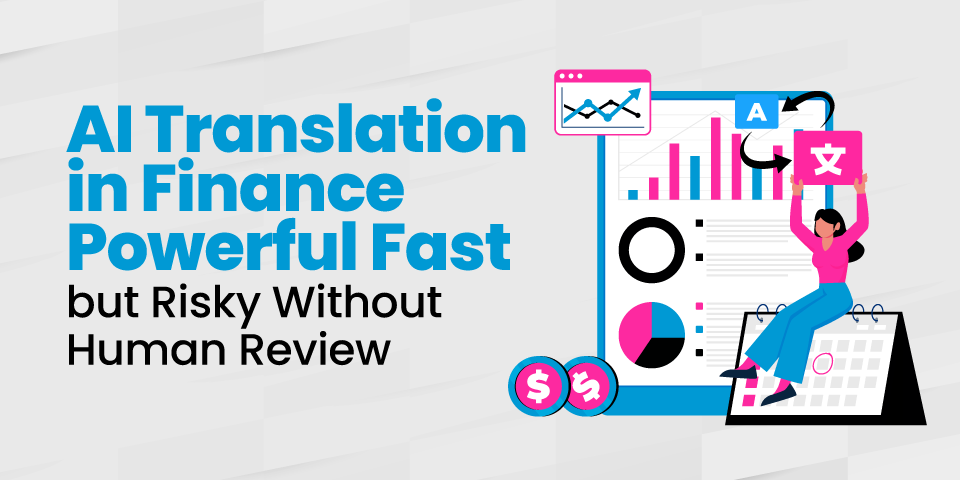
At NexTranslate, we see this firsthand while working with finance and fintech teams operating across regulated markets. AI translation is powerful—but in finance, it becomes risky without expert human review. The real solution is not choosing between AI and humans, but combining both to ensure speed without sacrificing accuracy, compliance, and trust.
The Rise of AI Translation in Finance
The finance industry is witnessing a remarkable transformation with AI translation tools. These technologies offer an efficient solution to handle the massive volumes of financial documentation. As global markets expand, the demand for quick and accurate translations in finance has skyrocketed.
AI translation tools appeal due to their rapid processing capabilities. They can translate thousands of words in mere seconds, which is invaluable for financial institutions dealing with time-sensitive data. Moreover, their cost-effectiveness makes them an attractive option for businesses looking to manage expenses.
However, the rise of AI translation is not without its challenges. While machines excel in speed, they often miss the mark in understanding complex terminology. The subtleties of financial language and regulations require more than just literal translations.
Key drivers of AI translation’s growth in finance include:
- Increasing demand for multilingual communication.
- The need for quick turnaround on translations.
- Cost efficiency compared to traditional methods.
- The exponential increase in digital financial transactions requiring swift interpretation.
Benefits of AI Translation for Financial Services
AI translation offers several key advantages to the financial services sector. First and foremost is the significant time savings. Financial institutions are under constant pressure to process and disseminate information quickly. AI translation tools provide near-instantaneous results, helping meet tight deadlines.
Cost reduction is another compelling benefit. Traditionally, translating financial documents involves substantial costs. AI tools offer a more budget-friendly alternative, making it feasible for businesses to manage translation workloads without inflating expenses. This allows financial institutions to allocate resources more effectively across operations.
Moreover, AI translation supports scalability. As a business grows and enters new markets, the volume of documents needing translation can multiply rapidly. AI systems can handle this increased demand without a corresponding rise in costs or time.
AI tools also excel in handling repetitive tasks. They can effortlessly manage and translate standard documents such as forms and reports, freeing up human translators for more intricate work requiring a deeper understanding.
Benefits of AI translation for financial services include:
- Rapid processing and delivery.
- Cost-effectiveness compared to traditional translation methods.
- Scalability to match business growth.
- Efficient handling of routine translation tasks.
- Freeing human resources for complex document translations.
The Risks and Limitations of AI-Only Translation
Despite the advantages, AI translation in finance has notable risks and limitations. One major concern is the potential for misinterpretation. AI systems often struggle with complex financial terminology, jeopardizing accuracy. Misinterpretations can lead to costly errors in financial reporting and analysis.
Another limitation is the lack of cultural nuance. Financial documents must not only translate the words but also the intent. AI tools lack the sensitivity to grasp cultural subtleties. This can result in translations that are technically correct yet fail to resonate with an international audience.
Compliance is a critical aspect. Financial documents must adhere to strict regulations and standards across different jurisdictions. AI lacks the judgment to ensure compliance, potentially exposing companies to legal liabilities. This oversight is particularly concerning in regions with complex legal frameworks.
Contextual understanding is crucial in finance. AI models can misjudge context and idiomatic expressions, leading to nonsensical or misleading translations. This highlights the AI’s dependency on predefined datasets and limited contextual awareness.
AI tools also face challenges with language variations and dialects, which are common in international financial markets. While they can handle routine tasks, they cannot replace the nuanced understanding required for high-stakes financial documents.
The limitations of AI-only translation in finance include:
- Inaccurate interpretations of specialized terminology.
- Inability to capture cultural nuances.
- Risks of non-compliance with regulations.
- Misunderstanding of context and idiomatic language.
- Challenges with variations in language and dialects.
Why Human Review Is Essential in Financial Translation
Human review in financial translation services is the critical checkpoint for precision and reliability. While AI can draft preliminary translations quickly, humans verify these for both accuracy and context. This human oversight is necessary to catch subtle errors that AI might overlook.
Expert linguists offer a deep understanding of financial jargon and local market contexts. They can adapt translations to specific audience needs, ensuring the message’s effectiveness. Human translators also infuse cultural relevance, which is crucial in building international relationships and trust.
Regulatory compliance is another area where human intervention excels. Translators familiar with financial regulations ensure documents meet legal standards. This prevents potential legal mishaps that could arise from inaccuracies or omissions in machine translations.
Furthermore, human-led reviews provide accountability. When a translation is cross-examined by professionals, it carries an added layer of quality assurance that AI alone cannot match. This scrutiny is vital, especially in sectors where precision affects financial decisions.
Key reasons for human review include:
- Precision in terminology and context.
- Adaptation to cultural and audience specifics.
- Assurance of compliance with financial regulations.
- Increased accountability and quality control.
- Enhanced understanding of complex financial content.
Compliance, Accuracy, and Cultural Relevance: The Human Advantage
Human translators bring distinct advantages in ensuring compliance across financial documents. They have expertise in understanding diverse legal requirements and financial regulations. This expertise is crucial in adapting documents to meet the specific standards of different jurisdictions.
Cultural relevance is another key area where human translators excel. They can tailor messages to suit the cultural and social norms of the target audience, increasing the resonance of the communication. This cultural sensitivity minimizes the risk of alienating international clients or partners.
Accurate translations demand more than just linguistic skills—they require an understanding of the intended message and its impact. Human translators can discern these nuances and ensure the subtleties of complex financial information are conveyed clearly.
Financial translation not only converts language but also bridges cultural divides. Human expertise in both local customs and financial practices enhances understanding and builds trust. This is particularly important in the diverse global market.
Human translation ensures:
- Adherence to local financial laws and standards.
- Harmonization of financial documents with cultural expectations.
- Clarity in complex financial narratives.
- Superior interpretation of nuanced language.
- Enhanced client relationship and trust through tailored communication.
The Role of Financial Translation Agencies and Fintech Translation Services
Financial translation agencies play a pivotal role in bridging linguistic and cultural gaps in global finance. They offer specialized services to meet the complex needs of international markets. These agencies employ native linguists who understand both local dialects and financial jargon, ensuring precise translations.
Fintech translation services are increasingly important as technology reshapes financial landscapes. They cater specifically to the needs of the fintech sector, where technology and finance intersect. This requires translators who are not only linguists but also tech-savvy and familiar with regulatory environments.
The adaptability of these services is crucial. Financial translation agencies must stay abreast of evolving international regulations and market trends. This enables them to provide accurate, compliant, and timely translations for their clients.
Agencies offer a wide range of services, including:
- Document translation and localization.
- Regulatory compliance adaptations.
- Market-specific financial consulting.
- Multilingual client communication.
- Cultural sensitivity training for financial teams.
Best Practices: Integrating AI and Human Expertise in Finance Document Translation
Successfully integrating AI and human expertise in finance document translation requires a strategic approach. It begins with understanding the strengths of AI tools—speed and handling large volumes of data efficiently. However, these tools must be complemented by the nuanced understanding that only human translators provide.
Human linguists excel at interpreting context, idiomatic expressions, and cultural subtleties—areas where AI often falters. They can ensure that translations are not only accurate but also resonate with the intended audience. Therefore, combining AI’s efficiency with human insight optimizes the translation process.
Organizations should implement a comprehensive review system. Drafts generated by AI tools should undergo thorough evaluation by experienced translators. This two-tiered process helps in maintaining both speed and accuracy in document translations.
Another best practice is continuous training for translators on AI tool functionalities. This training enables them to leverage technology better, enhancing overall translation quality. Staying informed about the latest advancements ensures that human translators use AI tools effectively.
Effective integration strategies include:
- Employing AI for initial drafts and repetitive tasks.
- Relying on humans for critical context and compliance checks.
- Regular training for translators on AI advancements.
- Establishing a seamless workflow between AI and human inputs.
- Reviewing final outputs with human expertise for nuance and accuracy.
Real-World Scenarios: Financial, Legal, and Healthcare Implications
In finance, a minor error in translation can lead to significant financial losses or regulatory breaches. For example, misinterpreted financial reports might skew investment decisions. Here, combining AI’s speed with human scrutiny ensures clarity and accuracy.
In legal contexts, precision is paramount. Legal consultants often face challenges with AI-only translations due to complex legal jargon. Human translators bring the expertise needed to navigate these intricacies, preventing costly legal misunderstandings.
Healthcare administrators need accurate translations for patient documents. Misinterpreting medical terms can have dire consequences, impacting patient care. AI can quickly translate large data sets, but human experts ensure these translations are contextually correct and culturally sensitive.
Specific implications include:
- Increased trust with culturally relevant translations.
- Improved compliance and risk management in legal documents.
- Enhanced patient care through accurate healthcare translations.
These scenarios highlight the essential role of human review in complementing AI translation capabilities.
Conclusion: Building Trust and Value with Human-Led Financial Translation
AI translation has undeniably transformed how financial organizations operate. It delivers speed, scalability, and cost efficiency—capabilities that are essential in today’s fast-moving global markets. However, when used in isolation, AI introduces risks that finance teams cannot afford to ignore.
Financial translation demands more than linguistic accuracy. It requires regulatory awareness, contextual judgment, cultural sensitivity, and accountability—areas where human expertise remains irreplaceable. Native linguists ensure that financial intent, legal meaning, and compliance requirements are preserved across languages and markets.
The most reliable approach is a human-led, AI-powered translation model—where AI accelerates delivery and human experts safeguard accuracy, compliance, and credibility.
At NexTranslate, we combine advanced AI translation with specialist human review to protect your numbers, your message, and your reputation. Partner with us to unlock the speed of AI translation without compromising compliance or trust—because in finance, speed matters, but trust matters more.